An updated competitor review, “Should You Use Callbox for Lead Generation?” generated booked calls for Belkins, which converted to appointments with mid-sized and enterprise CMOs and VPs of Sales:
| 6.6% conversion rate (CVR) in booked calls after 1 month of publication | 3 leads converted to deals (qualified booked appointments) after 3 months of publication |
Considering how competitive appointment setting is — ask any $10M outbound sales agency owner — the initial results look promising. So, how did we do it?
Skip ahead.
Opinionated, biased, and slightly salesy. Of all BoFu articles, competitor reviews are the toughest to write.
How do you create a balanced take? What should you cover so you can organically frame your solution as an alternative?
Turns out, as one-sided as competitor reviews can be, there’s plenty you can do to represent both sides authentically and drive qualified leads.
Belkins is an outbound lead generation agency for B2B companies.
Known for its bespoke omnichannel strategies, focused expertise, and vibrant experimentation culture, clients see 100+ appointments with key decision-makers annually.
Currently, Belkins ranks 5th on the coveted Clutch’s Global 1000 list, setting the gold standard in B2B marketing and sales today.
During our discovery call 18+ months ago, Belkins SEO lead Eugene Zatiychuk and content manager Iryna Yelisova shared their content pipeline goals:
Scale content with quality intact: Belkins had 80+ articles on the editorial calendar. Since it’d take the in-house team over a year to complete, Belkins outsourced the Tolkienian task to experienced B2B writers. Content Kapow (yep, that’s me!
) was one of them.
Become an exemplary B2B leader: Belkins wanted to show up as a leader in the B2B appointment setting space. To attract enterprise C-suites (CMOs & VPs of Sales), the articles needed advanced insights, not crumbs of elementary information.
Grow pipeline sustainably: Belkins treats every article as a landing page; all posts must drive high-intent clicks that convert to booked calls and qualified appointments. It’s not just about ranking or getting cited on LLMs.
There’s no shortage of freelance writers in this market.
However, if you’re looking for reliability, experience, and a shared taste on what makes great content, you need to go deeper than a writer call-out on LinkedIn.
That’s why Eugene started his search on the Omniscient-Certified Writer Database.
The Omniscient-Certified Writer Database was created by Allie Konchar (Decker), partner and chief client officer at Omniscient Digital. The writers in the database, including myself, had worked with Allie.
Since I was vetted by a content leader, Eugene knew he’d landed a reliable writer.
As for experience, my portfolio showed various clips on advanced marketing and sales topics. Eugene could tell I speak the C-suite’s language.
So this left only one question:
Did our content taste align?
You bet.
In fact, here’s the exact moment when Eugene discovered we share the same content standards:
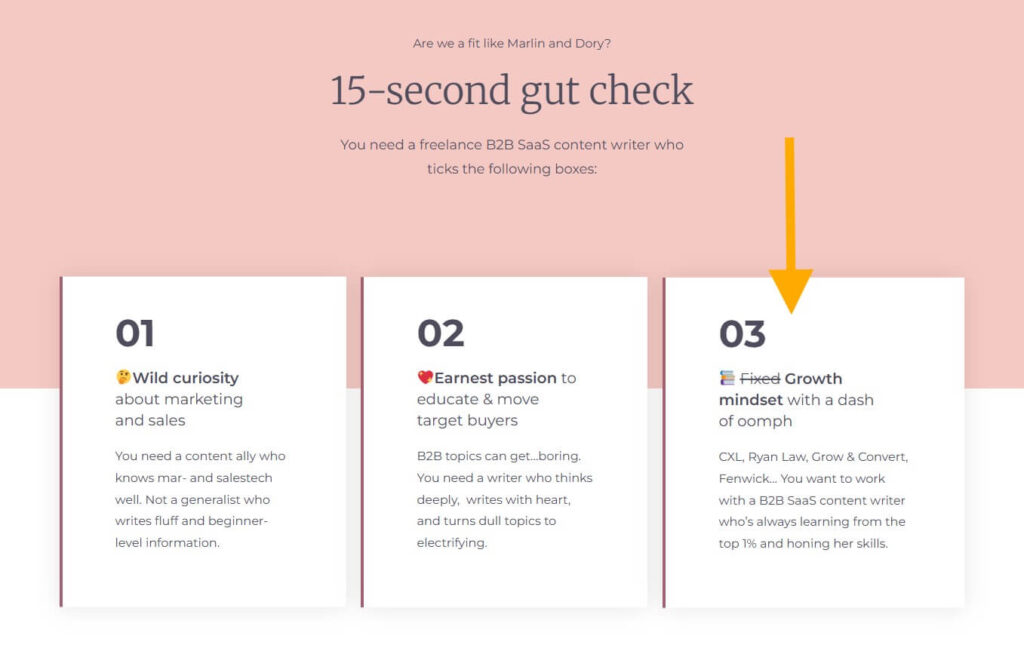
You have this 15-second gut check [on your website]. And you have Ryan Law and Grow and Convert in there. I learned from Animalz and Grow and Convert. So these are big names for me in terms of content quality.
Eugene Zatiychuk, SEO lead at Belkins
Side note: The Grow and Convert Content Marketing Course is the best program I’ve invested in my career.
Even though the course needs a GEO update, the foundations (e.g., originality nuggets, specificity strategy) are still 100% relevant to what makes conversion-focused content today.
Highly recommend it.
And so, off we got down to business.
At Belkins, all articles follow the same process. After a brief is provided, I’d interview the subject matter expert (SME), outline, and write the draft.
This competitor review, written 1+ years into our collaboration, is no different.
Here’s what went down:
Our process kicked off with a comprehensive content brief (provided by the Belkins team).
Nonetheless, I wanted to dig deeper for a complete and unbiased picture.
In my independent research, I looked for common pros and cons on G2, Clutch, and the /sales subreddit. I also analyzed follow-up queries* on AI search platforms like Perplexity.
*Why follow-up queries?
AI search systems use query fan-out, a technique that expands a prompt into multiple sub-queries. To raise your chances of getting cited here, cover the implicit and explicit context behind each query.
Example:
In the competitor review, I started with “How much does [competitor] cost?,” which expanded to:
Tip: To locate sub-queries on Perplexity, enter your first question and scroll down until you see Follow-ups. Go through them and select the most relevant to your subject matter or business.
After expanding on the research findings in the brief, we continued to the next stage.
As proud as I am of my research chops, I lacked firsthand experience in evaluating an appointment setter.
Both Eugene and Iryna suggested I speak to Michael Maximoff, the co-founder and chief growth officer of Belkins.
Since Michael’s worked closely with our target audience, he understands the irreversible impact of partnering with the wrong firm. More importantly, he can advise on what to prioritize when evaluating agencies.
Michael opted for async communication via Slack. After I sent over the questions, he recorded voice notes to share his perspective.
Tip: If the SME’s answer doesn’t corroborate your findings, challenge them. Contrarian views push the SME for a much nuanced take. You can’t find it on AI.
Your ability to find these opposing perspectives will depend on your consumption habits. My recommendation? Join active Slack communities, engage with experts on LinkedIn, and subscribe to newsletters, etc.
Each time you come across an interesting opinion, save it in your swipe file. You’ll likely revisit them later.
The SME questionnaire is one of the best I've had in my life. Priscilla asks questions that are thoughtful, interesting, logical, and fresh. It was a pleasure to ponder them.
Michael Maximoff, co-founder & chief growth officer at Belkins
After gathering all notes, I began outlining the piece.
First, I looked for the hook (a.k.a. thesis) and brainstormed how to position Belkins as an alternative.
In the original content brief, Belkins suggested leading with the competitor’s history or trajectory over the previous years.
It was decent, but I wanted a bolder opening statement.
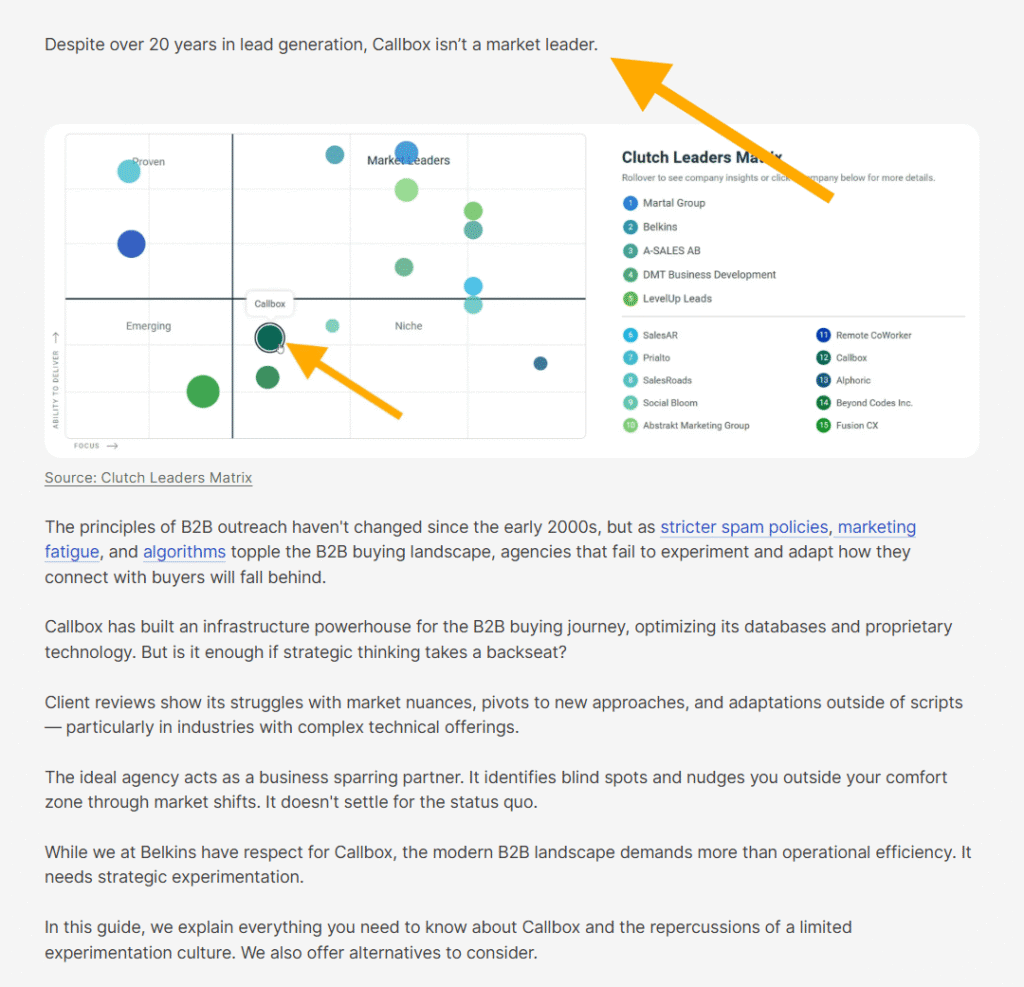
So I went back to our notes and discovered a startling fact: The competitor isn’t an industry leader despite being in the space for 20+ years.
Perfect, we’ve found the hook.
I also looked for opportunities to weave our editorial voice into the narrative. Since I’d been working with Belkins for over a year, it’s second nature to me at this point.
Example: I suggested how to negotiate a contract under the competitor’s pricing models (note: this was a contract negotiation tip Michael shared with me months ago).
Tip: Acknowledge the competitor’s strengths for a fair, balanced take.
In the competitor review, I credited its short ramp-up period and backed it up with a case study. To bring Belkins back into the conversation, I shared a tip about how mutual effort drives momentum in outbound campaigns.
The article format was also completely changed.
While the older version touched on the core points, it lacked the proper text format for AI models to understand and retrieve them.
Using an AEO checklist as reference, I updated the article (e.g., mirroring heading syntax, reducing dependency hops).
The first draft is completed. The Belkins team reviewed the insights, structure, syntax, and grammar.
Here’s a closer look at our multi-phase edit system:
Self-edit: I edited the piece using Fenwick’s Uncommonly Clear Writing principles. Here, I focused on precision, concision, and ease of reading. Grammar checks come later.
Expert insights: Michael examined the key points (like the core argument and brand positioning).
SEO: Eugene reviewed the anchor texts and internal links to improve the site structure and page authority.
Content guidelines: Iryna analyzed the syntax, style, structure, and overall flow of the article.
Priscilla balances creativity with discipline. She finds original angles and fresh ways to present complex information, but she never loses sight of our guidelines, brand voice, or strategic objectives.
Iryna Yelisova, content manager at Belkins
Final proofreading: A proofreader checked for potential grammatical and punctuation errors.
Done and dusted, Belkins scheduled the competitor review for publication.
6.6% conversion rate in booked calls after a month of publication. 3 leads converted to deals (qualified booked appointment) after three months.
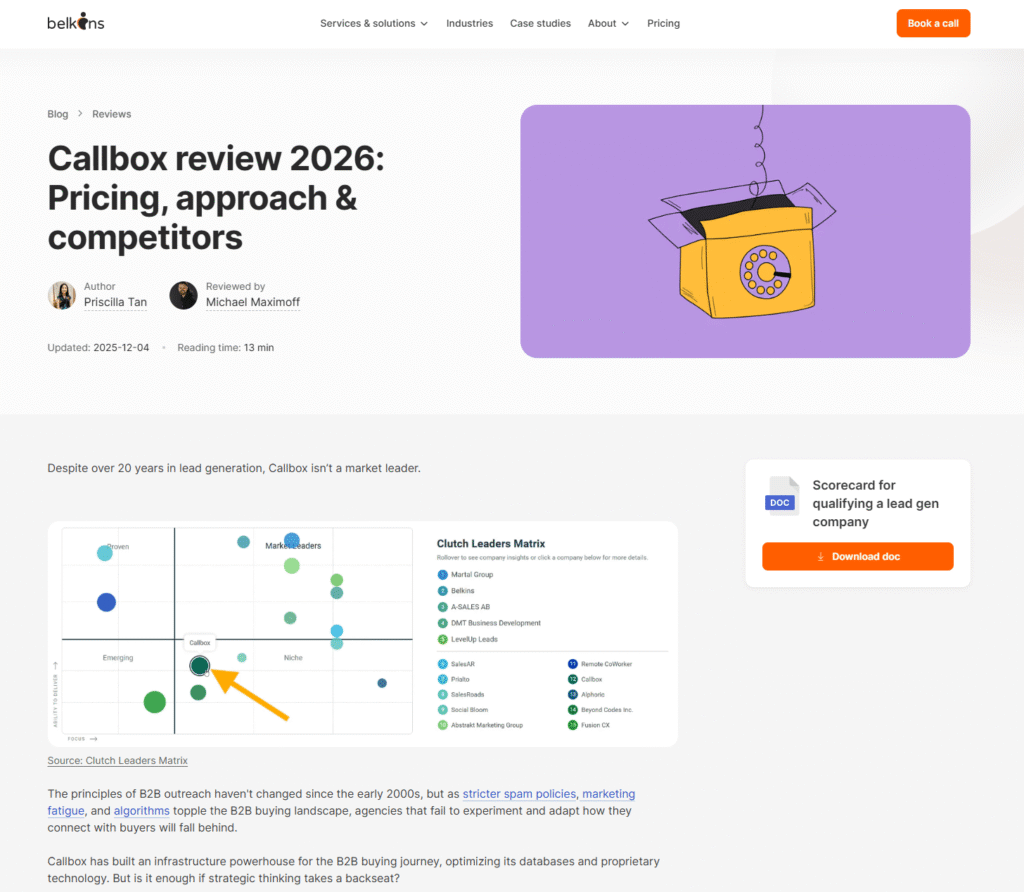
We also replicated the format for forthcoming competitor reviews: CIENCE, Martal Group, and memoryBlue.
I expect we’ll see similar conversions down the road.
The conversions wouldn’t be possible without Belkins’ active participation:
Content culture: Content is an-all-hands-on-deck effort at Belkins. Everyone in marketing, sales, management, operations was on standby mode to answer our questions.
Inimitable editorial voice: Belkins knows what it does best and what it stands for. With more brands singing the same tune, Belkins’ positioning and PoV is a powerful differentiator
I write experience-led content that lies in the intersection of marketing and sales. Every month, I work with 3-5 elite clients that want to show up as a leader, engage C-suites with a unique PoV, and improve their pipeline goals.
Sounds good?